All Big 4 use proprietary AI-powered audit platforms.
Updated Mar 12, 2026
Top Benefits Of Automated Financial Reporting Software 2026

Reporting is a burdensome process for finance professionals, as it takes a lot of time, while the scope of errors is also high. Last-minute reconciliations lead to a plethora of spreadsheets. Account analysts don’t value this low-value much. Expecting the work to be completed before the end of the month is foolish. And without reliable numbers, even leadership stays in the dark about the firm’s status till the last moment.
But automated financial reporting software has come to put an end to all this. Now, organizations are turning to them to accelerate this cumbersome disclosure process. According to AFP, embracing automation has led to 50% less time required for reporting with 90% less errors.
In this article, I’ll tell you everything about automated accounting software. From its key features and benefits to common mistakes that you should be aware of.
What Is Automated Financial Reporting Software?
Automated accounting software directly connects to your accounting systems, ERPs, and account databases, generating accurate reports.
Manual and repetitive data entry is a thing of the past. Now, these solutions quickly generate financial statements, pulling out data in real-time and validating it. These platforms convert accounts communications from a month-end burden into a continuous process that is faster and helps informed decision-making.
Key Benefits Of Automated Financial Reporting Software For Finance Teams
Automated accounting is reshaping the workflow of finance teams with the following benefits:
Faster Disclosures And Close Cycles
Automated accounting demands less time for compiling, validating, and publishing account statements. There is no need for manual data gathering and reconciliation either. This helps finance teams in pulling out data directly from source systems. As a result, reports don’t take days but hours for generations. The process speeds up month-end and quarter-end closes and gives teams enough time to focus on analysis rather than deadlines.
Improved Accuracy And Data Integrity
Manual reporting is prone to human errors of all kinds. However, when data is automatically validated and standardized across different financial reports, the risk of error is lessened. It helps finance teams quickly deliver high-quality numbers as built-in checks produce consistent accounting outputs.
Real-Time Visibility For Decision-Making
Automation solutions can also provide real-time access to financial data and a dashboard with accounting insights. Many finance teams also integrate the best invoice to cash software to streamline receivables, billing, and payment tracking.
Using this information, finance leaders and executives can monitor performance continuously and spot trends early. It becomes easier for them to adjust strategies quickly rather than waiting for stale monthly report.
Stronger Compliance And Transparency
Accounts reports automation also generates detailed audit trails and enforces consistent controls, which makes compliance with GAAP regulations and internal policies much easier. Since every transaction approval step and change is logged, the auditing process becomes much simpler and transparent.
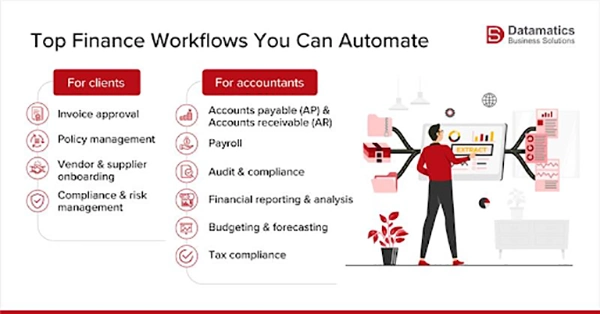
You can enjoy these benefits through automating various aspects of financial workflow, including disclosures. The following infographic lists all of them.
Core Features That Make Automated Financial Reporting Essential
The above-mentioned benefits are achieved through unique key features embedded in the automated accounting software. The following section discusses these features in detail.
1. Real-Time Data Aggregation And Integration
As we have discussed earlier, modern reporting automation software can pull data directly from ERP, accounting, and operational systems. This results in the aggregation of accounting information across departments and business units in a much faster way. This unified data, in turn, ends silos and makes sure that everyone is working from the same up-to-date numbers.
2. Automated Calculations And Error Reduction
The manual process of recording finances invites multiple mistakes, including mistyped numbers, incorrect formulas, and version conflicts. However, automated software can apply predefined logic and rules to every dataset, which makes calculations consistent and error-free. This feature boosts confidence in the numbers but also cuts back on time spent checking and rechecking results.
3. Workflow Automation And Task Management
Finance teams view reporting as a dependent process. It can only start when we get the final concrete numbers. Automated financial communications solutions standardize the workflows by assigning tasks, keeping tabs on progress, and sending alerts whenever input or approval is required. Hence, tasks keep moving forward without manual nudges.
4. AI-Assisted Close And Predictive Insights
Current reporting systems have started incorporating AI to accelerate the month-end close and highlight anomalies. AI is better at recognizing patterns and suggesting relevant adjustments for the reconciliation of accounts statements. It can also flag areas that require attention, which adds a layer of automated sight that manual processes cannot match.
Common Mistakes To Avoid When Implementing Automated Financial Reporting
Automation benefits no matter what. But to maximize those benefits, you should keep some best practices in mind. Some common mistakes to avoid are as follows:
- Ignoring Data Quality: If you automate accounting without first standardizing and validating source data, it will generate inconsistent reports and ongoing reconciliation problems that erode stakeholder trust
- Unclear Implementation Goals: Deploying automation without defined reporting objectives, KPIs, or performance benchmarks can easily make it difficult to measure ROI. It often results in underutilized system capabilities
- Skipping Process Evaluation: Existing disclosures workflows must be mapped and optimized before automation. Otherwise, manual processes will be digitized with all inaccuracies
- Weak Change Management: Leadership should be aligned with policies, and communication with teams should be strong. Otherwise, it will lead to slow adoption of reporting software
- Insufficient Staff Training: If you skip the provision of structured onboarding and ongoing support, your finance teams may revert to spreadsheets or create manual workarounds. This practice will directly undermine automation benefits
- Poor System Integration: Testing of automated disclosure software must be adequate, else it will only result in data silos, duplication, and reporting inconsistencies
- No Ongoing Optimization: Treating implementation as a one-time rollout instead of continuously refining processes and controls will limit the long-term efficiency gains of your company
Final Thoughts On Automated Financial Reporting Software Benefits
Automation is a necessity in this highly competitive AI-era. The same is true for the finance world. Automated accounting software can help you move from reactive disclosures to a proactive strategy by taking control of the accuracy of accounting reports, closing cycles, compliance, and real-time financial insights. In 2026 and beyond, firms that keep modernizing their reporting processes will be better positioned to grow and lead with confidence.
Author - Shourya Kumar

Finance Writer
Table of Contents
- What Is Automated Financial Reporting Software?
- Key Benefits Of Automated Financial Reporting Software For Finance Teams
- Core Features That Make Automated Financial Reporting Essential
- Common Mistakes To Avoid When Implementing Automated Financial Reporting
- Final Thoughts On Automated Financial Reporting Software Benefits
Related Posts