For this, you can use a fixed-fractional position sizing model to make sure that you risk less as your account balance decreases.
Updated Mar 9, 2026
Compound Interest in Active Trading: Modelling Return Path Dependency and Drawdown Control for Portfolios
“Compounding is the greatest mathematical discovery of all time.” – Albert Einstein (Theoretical physicist)
Imagine moving towards financial freedom, only to slide back three steps for every two steps you take forward. Einstein called compound interest the ‘eighth wonder,’ yet it is often mistaken by traders for a static formula.
In practice, behavioral finance shows a significant gap because investors expect linear 8-10% returns, which actual market conditions and their timing errors will reduce by 2-3%.
To master active trading, you need to stop viewing compounding as a passive reward. Instead, you need to treat it as a fragile engine that requires constant protection. Mastery is not just about chasing growth; it is about shielding your capital from erosive forces of market turbulence.
Key Takeaways
- Protecting your capital is more essential than chasing high-percentage wins.
- The sequence of your trades determines your ultimate portfolio size.
- Deep drawdowns are significantly harder to recover from.
- Small and steady gains often outperform lumpy high returns over time.
Rethinking Compound Interest in Active Trading

When you hear ‘compounding,’ it may lead you to think about a savings account, which can increase its value without anyone observing its growth. The active trading environment generates an unpredictable and dynamic framework that induces compounding effects among traders.
It is not just about earning interest on interest; it is about the mathematical advantage of keeping your capital base intact so that your next winning trade has more fuel to burn.
The legendary trader Paul Tudor Jones once said, “The most important rule of trading is to play great defense, not great offense.” One is supposed to shift their mindset from how much they can make to how much of their previous gains they are willing to risk.
Return Path Dependency and Its Impact on Compounding
Have you ever wondered why two traders with identical average returns mostly end up with vastly different balances? Well, it is ‘Return Path Dependency!” The sequence of your wins and losses decides your final wealth.
Losing 50% early needs a 100% gain just to break even, but a late-career crash on a larger capital base is even more catastrophic.
Fun Fact: If you begin with $0.01 and double it every day for the next 30 days, you will have over $5 million. However, if you lose just 50% on day 29, you would lose over $2.5 million in a single blink!
Compounding depends on momentum; path dependency is the fraction that can actually halt your progress. The order of returns is the true master of your portfolio.
Drawdowns: The Silent Enemy of Compounding
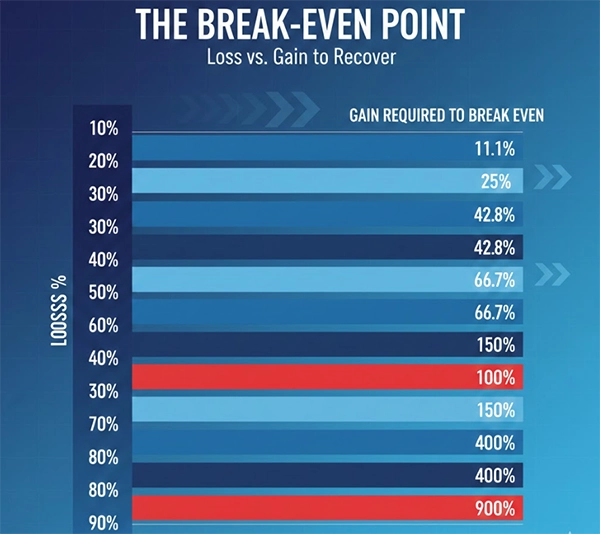
Drawdowns are actually structural threats and not just bad days. The math of loss is brutal: a 10% dip requires 11% recovery, but a 20% drop demands 25%. To protect your compounding engine, you need to implement ‘circuit breakers.’
You can use disciplined stop-losses to ensure that on trade never breaks you, scale positions based on volatility rather than gut feeling, and monitor your equity curve like a stock.
By restricting the pullbacks, you ensure that your capital base stays healthy enough to power your future growth. This chart shows loss percentage vs gain required to break even.
Modelling Compounding Realistically
All the traders must establish their trading path through accurate modeling, which includes all relevant costs and market behavior, and most crucially, all profit variations.
The compound interest calculator enables you to see how minor changes in your withdrawal percentage and loss limits create major differences in results after ten years.
Using a compound interest calculator can help you visualize how even small adjustments in your win rate or drawdown limits can actually lead to exponential differences over a decade.
By simulating these real-world frictions, you can transform a simple mathematical theory into a strong and executable strategy for long-term wealth.
Did You Know?
‘Volatility Drag’ is the term that is used to describe how the variance in returns actually reduces the geometric mean of your portfolio and makes compounding less efficient.Conclusion
Active trading is a marathon run, and that too through a minefield. Compound interest is your greatest ally, but only if you respect its fragility. By understanding return path dependency and keeping a tight leash on drawdowns, you can shift trading from a gamble into a mathematical certainty.
You need to protect your base, manage your path, and let time do the heavy lifting. By focusing on risk management over raw percentage gains, you make sure that the power of geometric growth remains working for you.
Author - Dushyant K

Finance Writer
Related Posts