Because multiple cost layers (ads, suppliers, fees) make it easy to miscalculate profits. Proper accounting ensures you know your real earnings.
Updated Mar 30, 2026
Accounting for Dropshipping Businesses

“Revenue is vanity, profit is sanity, but cash is reality.”
– Alan Miltz (Financial Consultant)
That line hits especially hard in dropshipping. On the surface, it looks like an easy, low-risk business model. No inventory, minimal upfront costs, and global reach. But behind that simplicity lies a financial maze.
Because when you’re juggling ad spend, supplier payments, platform fees, and fluctuating margins, it’s surprisingly easy to make sales… and still lose money.
That’s why accounting isn’t just a backend task in dropshipping. It’s your survival toolkit. The right systems and tools help you understand what you’re actually earning, not just what’s coming in.
In this article, I’ll teach you how to manage accounting for dropshipping businesses, track real profits, handle taxes, and optimize financial performance with practical tools and strategies.
KEY TAKEAWAYS
- Dropshipping profitability is hard to track as small fees and taxes can significantly impact margins.
- Cash flow timing can create misleading profit signals.
- Perform per-order profitability analysis.
- Financial tracking tools improve decision-making and scalability.
Understanding the Dropshipping Financial Flow
At first glance, the money flow in dropshipping seems straightforward.
The customer pays you, you pay the supplier who also delivers the product to the customer, and you keep the difference.
This sounds easy, but the timing of payments and expenses can make cash flow tricky.
Suppose you receive customer payments immediately, but advertising and supplier expenses may be made at a later time. You may not count up your true profits without following this flow.
With a profit margin calculator, you can dissect every transaction so that you can have a clearer picture of how much you make after deducting all costs related to the transaction.
Key Accounting Concepts for Dropshippers
Before you scale, you need to speak the language of your numbers.
- Revenue is the amount of money generated by sales.
- Cost of Goods Sold (COGS) involves the amount you pay your suppliers of goods.
- All other costs comprise operational costs that include advertising, platform fees, payment processing fees, and tools.
Gross profit is computed by deducting COGS from revenue, whereas net profit includes all the expenses. The discrepancy between the two numbers can greatly affect your business choices.
Setting Up Your Accounting System
If your numbers are scattered, your decisions will be too. Financial clarity is pegged on a good accounting system.
You will have to decide on cash and accrual. Cash accounting records transactions as they occur, and accrual records as they happen, independent of when they are paid. Cash accounting is easy and simpler to handle for most beginners.
Then establish a simple chart of accounts. This ought to capture items such as sales revenue, product costs, advertising costs, transaction costs, and software subscriptions.
Adopting tools like profit margin calculators with your accounting system can help you have real-time information about your financial performance.
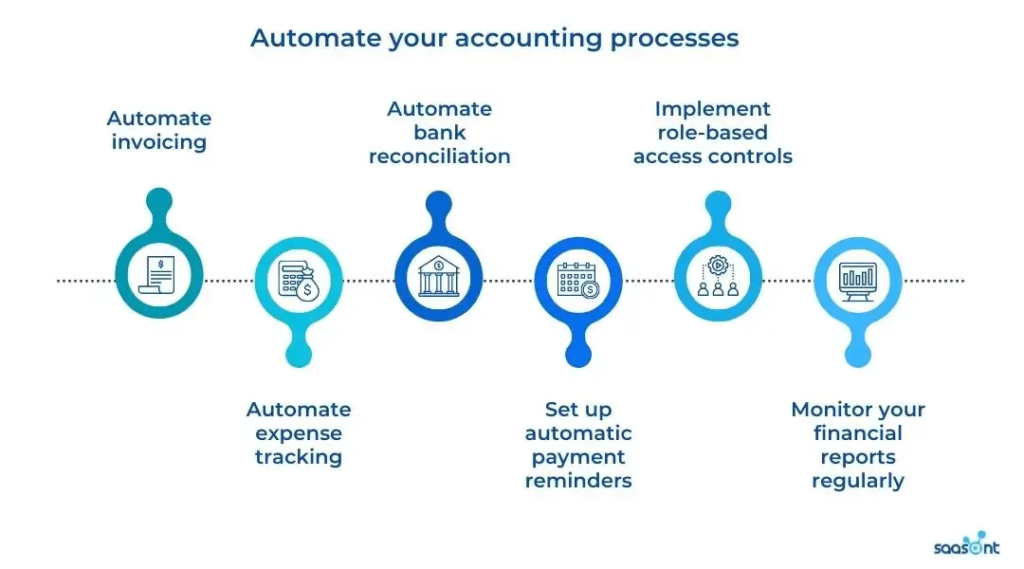
You can automate various accounting processes in your dropshipping business as per the following infographic:
Tracking Income and Expenses
Here’s where most dropshippers either win or quietly fail.
All sales must be tied to their cost. This makes you know how to compute your gross profit. Meanwhile, monitor all other costs that include Facebook Ads, TikTok Ads, Shopify, and payment processing costs.
It is particularly helpful to analyse the profitability per order. Calculating against every transaction, you can see where you are making a profit and where you are losing money.
With this degree of detail, you will be able to make well-informed pricing, marketing, and product choices.
Managing Taxes and Fees
Taxes in dropshipping aren’t just complicated. They’re easy to underestimate.
When you are selling to foreign countries:
- Sales tax
- VAT
- Cross-border tax rules
Additionally, account for transaction fees from payment gateways, platform subscriptions, and currency conversion charges. All these little expenses may accumulate and make a huge difference in your bottom line.
A profit margin calculator will give you an idea of the amount of money you actually have after taxes and fees, so you are not taken by surprise by the size of the deductions.
Financial Reporting and Optimization
Tracking numbers is good. Using them is where growth happens.
Periodic financial review keeps you in control.
Check your income statements to learn about your revenue, expenses, and net profit over time. Keep track of your cash flow so that you do not run out of money to pay continuing expenses.
Monitor important indicators such as:
- Profit margins
- Cost of acquiring customers
- ROA
These can be used to understand where you need to improve and develop.
A profit margin calculator is a vital part of this process as it enables you to compare various situations, including price adjustments with suppliers or ad spend, and determine the effect of each on your profitability.
Conclusion
Dropshipping may look simple on the surface, but financially, it demands discipline.
You can create a profitable and sustainable business by learning how to manage expenses and income. Tracking your financial flow teaches you how to manage your taxes.
Spreadsheet software can make intricate computations easier to understand and make you a more intelligent decision-maker. The fact is, in a competitive market, not knowing your numbers is not an option.
Author - Dushyant K

Finance Writer
Related Posts