Track spendings, proper budgeting through 50-30-20 method, and reduce debt as well.
Updated Mar 26, 2026
How Minimalist Money Habits Can Reduce Financial Stress

Other habits might run your day, but monetary habits define it.
Spending money mindlessly while debt piles up can lead to considerable economic hardship. And that in turn damages your sleep, relationships, and even health.
As per a CNN survey, money problems are the #1 stressor for 71% people.
The situation doesn’t develop in a day or due to a single bad event. It gradually grows through cluttered bank accounts, lack of budget planning, and everyday small financial decisions that you don’t give a thought to.
Tools like budget calculator app can really help in a situation like this as it visualizes everything, from income and fixed costs, to safe spending limits.
But embracing economic minimalism as a comprehensive and permanent solution to all your money woes. It doesn’t mean living on frugality extremes; it just removes all financial fog. Just embrace some monetary minimalism habits and get clarity around your finances. This removes the concept of financial stress from your life entirely.
In this article, I’ll define minmalistic monetary behaviour to help reduce your money-related stress. These simplify money management, clarify priorities, and build lasting financial wellness. The following sections enumerate practical, evidence-based steps and tools that make money habits easier to sustain.
KEY TAKEAWAYS
- Bad money management can quickly lead to chronic financial stress.
- To solve that, embrace minimalistic financial management.
- Take fewer monetary decisions daily through automated payments, and spend intentionally even for the rest.
- Eliminate financial clutter with budgeting income, expenses, and everything in between.
Why Fewer Financial Decisions Mean Less Financial Stress
Fear strikes the moment you have to take a money matter into your hands. Fill your day with many monetary decisions, and financial strain becomes your constant partner throughout the day.
Decision Fatigue And Money Management
Every purchase requires a choice. Subscriptions, impulse buys, payment plans, and credit offers compete for attention. Over time, this overload leads to decision fatigue.
Experts cited by Investopedia’s expert-backed money advice explain that automating core finances reduces anxiety. When fewer decisions demand attention, the brain conserves energy. That energy can support long-term planning instead of short-term reaction.
Minimalist financial behaviour reduce the number of moving parts in money management. Fewer accounts, fewer subscriptions, and fewer categories mean fewer chances for error. As a result, monetary stress declines because the system feels manageable.
The Core Money Habits That Simplify Finances
The following habits simplify your finances to the core so that you no longer fear monetary woes.
1. Intentional Spending With Clear Limits

Minimalism encourages spending aligned with values. Instead of tracking dozens of categories, households define three to five priority areas. Housing, food, savings, transportation, and one lifestyle category often cover most needs.
This structure prevents emotional overspending. According to consumer credit research summarised by nonprofit financial counsellors, structured spending plans reduce reported stress levels. When expectations are clear, uncertainty fades.
To implement this habit, many families use a digital budget calculator app. By seeing real numbers, households replace guesswork with evidence.
That shift alone answers the common question: What are some ways to reduce economic hardship? Clear limits create predictable outcomes.
2. Automation Over Willpower
Willpower fades under pressure. Automation does not. Minimalist money habits prioritise automatic transfers to savings and automatic bill payments.
When savings move immediately after payday, the remaining balance becomes the spending boundary. This method aligns with behavioural finance findings. People are less stressed when savings feel “locked in.”
Automation also supports economic wellness by reducing missed payments. Late fees and penalties create avoidable financial stress. A simple automated system removes that risk.
3. Reducing Financial Clutter
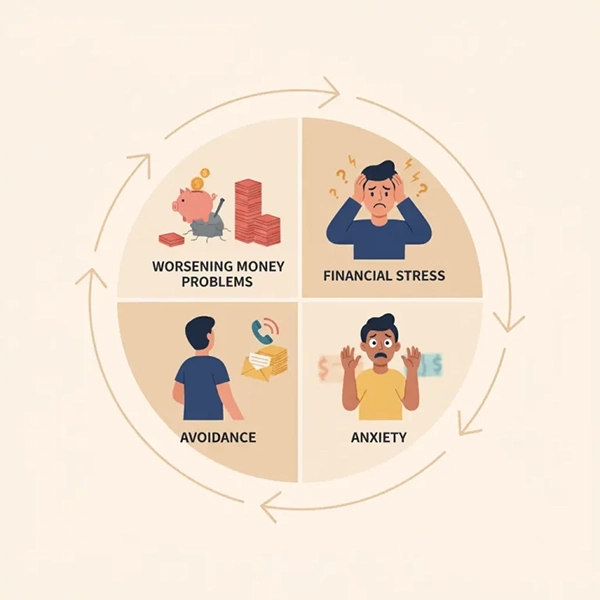
Clutter is not only physical. Multiple credit cards, unused subscriptions, and scattered investment accounts complicate money management. This is usually created by the vicious economic strain loop depicted in the following infographic:
Minimalistic financial behaviour encourages consolidation. Closing unused accounts and cancelling redundant services simplifies oversight. Each eliminated line item removes one source of monitoring.
Smart tools and apps to simplify finances can support this process. They categorise transactions automatically and highlight recurring charges. When unnecessary expenses become visible, decisions become easier.
The Psychological Link Between Minimalism And Financial Wellness
Minimalism means fewer things to worry about. Fewer things are easier to control as well.
According to financial counselling research, perceived control strongly influences stress levels. When people believe they understand their finances, anxiety drops.
Money habits rooted in simplicity increase that sense of control. Instead of reacting to every bill, households operate from a plan. The plan reduces surprises, and fewer surprises mean less monetary stress.
Progress Feels Tangible
Minimalist systems highlight progress. When savings goals are clear and tracked monthly, improvements become visible. That visibility strengthens motivation.
Behavioural studies show that small, measurable wins reinforce consistency. Consistent financial behaviour build stability. Stability supports long-term economic wellness.
From Overwhelm To Order: A Realistic Example
Consider a household juggling:
- Five subscriptions
- Two credit cards
- Inconsistent savings
- Unpredictable bills
Arguments increase, and financial strain builds each month.
Now imagine that same household adopting minimalist money habits. They do the following:
- Cancel unused services
- Automate savings
- Track spending through one dashboard
Within three months, spending patterns become predictable.
Nothing dramatic changed. Income stayed the same. Yet monetary stress declined because complexity declined. Order replaced chaos.
That is the quiet power of focused money habits.
Small Money Habits, Big Emotional Impact
Minimalist money doesn’t mean extreme frugality. You simply take some intentional decisions:
- Limiting categories
- Automating essentials
- Removing clutter
And the household money management transforms into a calm routine.
Economic hardship often grows from uncertainty. Minimalism replaces uncertainty with structure. Structure supports financial wellness and long-term confidence.
So here’s the real question: which monetary behaviour could be simplified today to create more clarity tomorrow? Share experiences, challenges, or strategies that have reduced financial stress in daily life.
Author - Shourya Kumar

Finance Writer
Related Posts