It is the process of designing a 3-5 year total rewards package (salary, equity, bonuses) that aligns with company growth, ensures retention, and manages cash flow.
Updated Jan 31, 2026
Beyond the W-2: Strategic Forecasting for Multi-Year Compensation
KEY TAKEAWAYS
- Learn about incorporating projected changes in tax law
- Understand how to build a professional advisory framework
- Discover ways to uphold professional rigor in personal finance
Strategic planning, or looking ‘beyond the W-2,’ is mainly about realizing that paying your best people isn’t just about the cash they see on their paycheck every year; it’s a long-term, multi-layered game to keep your top talent motivated and invested in the company’s success and less likely to leave for a competitor.
Instead of giving a 3% raise every January, you are mapping out a three- to five-year journey that combines a solid base salary with non-cash goodies. Like company stock options, performance-based profit sharing, or even extra, personalized perks like career development funds.
Companies can do it by actively analyzing their budget, checking the industry salary trends, and forecasting the company’s growth to figure out when and how to reward people.
Let’s continue with this guide and understand how this approach turns compensation into a strategic tool that reduces turnover, boosts loyalty, and keeps your company competitive without breaking the bank on immediate, high-cost, short-term raises.
The Foundational Tool: Accurate Withholding Modeling for Current and Future Periods
The first crucial step in any robust financial projection is setting an accurate baseline for cash inflows. For US compensation, this translates to modeling withholding not as a flat percentage but as a part of income level, filing status, and critical geography.
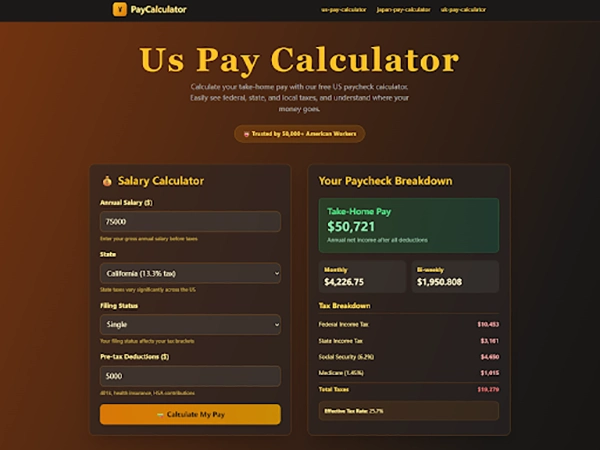
A comprehensive US Pay Calculator works for this exact purpose. It works as a specialized financial modeling engine, processing gross income by using the specific algorithms of the recent Internal Revenue Code and state revenue regulations.
It features the compulsory line-item breakdown of federal tax, FICA, and state tax that converts a gross salary into a reasonable net income forecast. This is the crucial first data point for any personal cash flow model or client advisory report.
Strategic Foresight: Incorporating Projected Changes in Tax Law
Professional financial planning, particularly for multi-year commitments like labor contracts or equity grants, should look beyond the present fiscal year. Tax brackets are tailored for inflation, legislation can change deductions, and state policies evolve.
This is where a static calculator becomes worthless. Using a 2026 Federal Income Tax calculator that combines IRS-projected adjustments for tax brackets, regular deductions, and contribution limits is a matter of professional accuracy.
It allows for the implementation of a multi-year compensation standard that accounts for the marginal tax result of bonus income, the phased vesting of equity, and potential shifts in residency.
For an executive weighing an employment proposal with significant variable pay, this forward-looking analysis is not optional; it is essential for understanding the net value of the entire package over its full term.
From Data to Decision: Building a Professional Advisory Framework
With detailed and reliable, forward-looking net income projections, the analysis proceeds from basic arithmetic to highly strategic financial advisory.
- Structuring Compensation for Optimal Efficiency. Advising a client on negotiation strategy needs modeling various scenarios. Does a greater base salary in a high-tax state deliver better long-term value than a weaker base with a bigger equity grant?
Can bonuses be structured to lessen the marginal tax hit? A specialized pay calculator allows this scenario analysis, changing compensation discussion into a strategic optimization issue.
- Conducting a True Net Present Value Comparison. Comparing offers in different states or with different blends of cash and equity must involve a common denominator: after-tax cash flow.
A robust toolset is needed for the modeling of each offer’s net cash inflows over time, discounted properly, to decide which comes with the greatest economic value on a risk-adjusted basis.
- Addressing Compliance and Cash Flow Risk. Relocating and multi-state income indicate complex filing obligations and possibilities for under-withholding.
Sophisticated, location-specific calculations help detect these risks in advance, enabling corrective evaluated tax payments or withholding adjustments to limit penalties and guarantee smooth cash flow for the individual or the client’s household.
Upholding Professional Rigor in Personal Finance
The root principles of our profession—accuracy, foresight, and verification—apply unequivocally to personal financial issues. The “tax bracket myth” is a very common computational mistake, a false understanding of marginal rates that a professional tool immediately corrects with transparent calculations.
For the accounting expert, leveraging these specific tools is an extension of fiduciary responsibility, whether to a potential client or to one’s own financial plan. It switches speculation with simulation and tiring guesswork with a governed forecast.
Before deciding on an analysis of a US compensation package, uphold the standard. Step beyond the gross figures. Model the net cash flows with accuracy, integrate forward-looking tax assumptions, and arrive at a valuation that demonstrates real economic conditions.
It is the most analytically sound method for one of the most important financial decisions a person can make.
Author - Dushyant K

Finance Writer
Related Posts