Employers look for soft skills such as emotional intelligence and the ability to work well in a team.
Updated Mar 24, 2026
What Employers Look for in Accounting Candidates

When you apply for accounting jobs, the primary quality that employers look for is a clear idea of the values associated with accounting. They review an accountant resume example to analyze the key qualities.
A good resume might make a nice first impression, but what actually matters at the next step is technical ability, awareness about the business, and good communication skills.
This stage is where many applicants either separate themselves or blend into the pile.
Read this article to learn what employers actually seek in candidates, which will help you ace your interview.
Key Takeaways
- The technical skillset that differentiates you from others is the key skill of analysing the financial statements, journal entries, and more.
- Analyzing the right candidates requires attention to detail, which involves studying the key characteristics of such employees.
- Moving beyond Excel and getting a hold of other technology-based apps and software is an important aspect to consider while hiring.
- Business awareness is yet another important aspect while considering the ideal candidate for accounting, as it involves active market play and current updates in knowledge.
Strong Technical Foundation and Soft Skills
Before anything else, employers want proof that you can handle the fundamentals.
That means:
- Understanding Financial Statements
- Reconciliations
- journal entries
- month-end processes
- Understand tax basics and the logic behind the numbers, not just the steps.
Whether the role is in audit, bookkeeping, payroll, management accounting, or financial reporting, employers need confidence that you can do accurate work without constant supervision.
That matters even more because accounting remains a steady field with real demand, with 5% projected growth for accountants and auditors from 2024 to 2034.
Most employers do not expect entry-level candidates to know everything.
In fact, a candidate who understands debits and credits and can explain the purpose of a balance sheet will usually make a better impression than someone who throws around advanced terms without clarity.
Soft skills also show up strongly in hiring data.
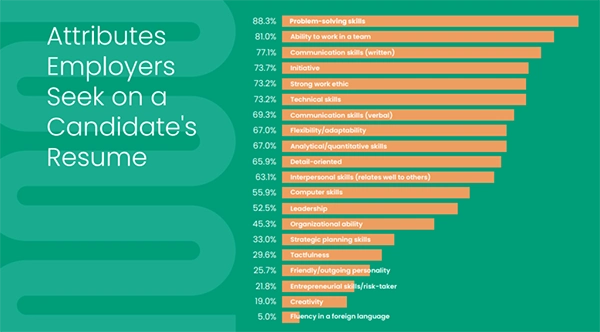
Employers say the top attributes they seek on a candidate’s resume include problem-solving skills (88.3%), the ability to work in a team (81.0%), and written communication skills (77.1%).
Attention to Detail
A missed decimal, misclassified expense, duplicate payment, or incorrect posting can create far-reaching problems.
Employers know these issues, so they look for evidence that you take accuracy seriously.
Attention to detail is about having a process.
Excellent accounting candidates:
- Check their work
- Keep files organized
- Name documents clearly.
- Follow deadlines
- and understand that consistency matters.
Employers notice when someone can work methodically without creating bottlenecks.
This is also where internships, part-time finance roles, coursework, and project work can help.
Even if you do not have years of experience, you can still show that you know how to handle financial information responsibly.
A candidate who can describe how they reconciled accounts for a student organisation or cleaned up reporting errors already sounds infinitely more credible than someone who only lists “detail-orientated” as a personality trait.
Communication
If you cannot translate numbers into decisions, your technical skills lose some of their value, especially in roles that involve clients, cross-functional teams, or advisory work.
At firms that provide accounting services, employers often look for candidates who can seem professional and trustworthy from the first interaction, because they know clients want more than compliance.
Good communication also signals maturity.
It tells employers you are less likely to create confusion or escalate small issues into bigger ones.
In practice, that makes you easier to train and easier to trust.
Technology Skills
Employers still care about Excel, but the bar has moved beyond basic spreadsheets.
Depending on the role, they may also want experience with:
- cloud accounting platforms
- ERP systems
- reporting dashboards
- workflow tools
- or automation features.
Even when a company is willing to train you on its exact systems, it helps if you already show comfort with financial technology, because accounting work is constantly changing.
Routine tasks are increasingly automated, while higher-value work is shifting toward review, interpretation, exception handling, and advisory support.
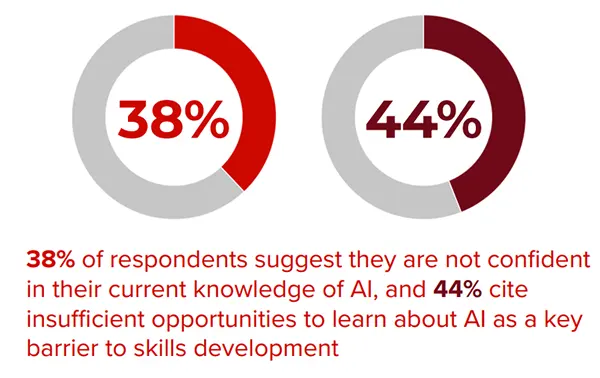
ACCA’s Global Talent Trends 2025 report identified AI proficiency as the most valuable skill for the future, while 38% of respondents said they were not confident in their current AI knowledge, and 44% cited too few opportunities to learn AI skills.
Employers do not necessarily expect every accounting candidate to be an AI expert, but they do want people who are comfortable learning new tools and adapting as the work evolves.
Business Awareness
Employers appreciate people who do not see accounting as isolated data entry but as part of how a business plans, grows, controls costs, and stays compliant.
This matters particularly in roles connected to owner-managed companies and smaller firms.
Many employers serving small businesses need candidates who understand that clients care about cash flow, profit margins, payroll, deadlines, and practical advice, not just technically correct records.
For example, instead of just saying you “prepared reports”, say you prepared reports that helped identify overspending or support month-end decision-making.
That is the kind of language employers remember.
Summary
What employers look for in accounting candidates is a little broader than many people expect.
Yes, they want technical knowledge and accuracy. But they also want communication, judgment, adaptability, and a real understanding of how accounting supports business goals.
The candidates who stand out usually combine reliable fundamentals with practical thinking; they are the ones on board.
Author - Shourya Kumar

Finance Writer
Related Posts