The 5-steps to reconciling accounts are: i) gather documents, ii) compare transactions, iii) identify discrepancies, iv) make adjustments, and v) document and review.
Updated Feb 12, 2026
A Comprehensive Guide To Reliable Account Reconciliation Workflows
Reconciling accounts is not an easy process involving just ticking boxes. It’s a real toll-taking work. SMEs doing account reconciliation take upto 10 days to process a single invoice (Source).
Being one of the backbones of the financial reporting process, this part falls at an intersection of policy, people, processes, and technology.
In this guide, I will break down the process of reconciling accounts into a reliable workflow involving practical steps. The workflow will also have controls so that the reconciliation can hold up even under severe scrutiny.
KEY TAKEAWAYS
- Define a clear workflow with standardized templates with easy checklists.
- Map tasks to roles and keep duties segregated to reduce errors and avoid fraud.
- The workflow should align well with financial control standards.
- Reduce exceptions every month to avoid year-end workload.

Define The Workflow And Roles
Start by defining a simple workflow for your account reconciliation from source to sign-off. The following points need to be clear:
- Ledger account
- Data inputs
- Preparer
- Reviewer
- Deadline
When people know their lane and the handoff, you cut rework and reduce last-minute surprises.
Document each step in a one-page process sheet. Include what to do, where to get data, and how to check it. Make that sheet the single source of truth, and store it where everyone can find it. Clarity is the quickest path to consistency.
Enforce Segregation Of Duties
No one person should prepare, approve, and post entries for the same account. That small rule blocks many errors before they start. It also keeps your control story clean when auditors ask who did what and when, The Southwest Recovery team and other debt collection services often emphasize clean handoffs in their own operations – the same thinking applies in finance. Build your workflow so each sensitive step has an independent set of eyes.
Use assignments and calendar holds so approvals do not slip. If your team is lean, rotate reviewers across months so oversight stays fresh. For higher-risk accounts, add a second review monthly and a spot check mid-close.
- Separate the preparer and approver for every reconciliation
- Restrict posting rights for high-risk accounts
- Rotate reviewers on small teams
- Add a second review for material or judgment-heavy balances
Create Standardized Checklists And Templates
Standard templates accelerate the reconciliation process, saving you precious time. Every reconciliation pack should include the same parts:
- Beginning balance
- Activity tie-out
- Reconciling items with dates
- Support links
- Attestation
If an item is judgment-based, write the rationale in plain language.
Add a short checklist to each template. Two or three yes-or-no questions are enough: Does the subledger tie to the GL? Are reconciling items dated and explained? Has aging been reviewed for stale items? A checklist nudges good habits and cuts back on back-and-forth.
Use Automation And Reproducible Evidence
Automate the repetitive manual tasks that take up your precious time for unnecessary routine tasks. You can always validate the output later.
You can easily automate the data collection process that pulls data from the general ledger, subledgers, bank accounts, and invoices. The data collected is also time-stamped.
Use scripts or low-code tools to refresh schedules, flag variances, and roll forward prior-month items. The goal is not fancy tech – it is evidence you can reproduce on demand.
Keep your evidence close to the numbers. Link directly to bank statements, invoices, and subledger reports. If you convert files, save the source and the converted copy together. When someone else can repeat your steps and get the same result, you have a reliable reconciliation.
Align With Internal Control Standards
Your account reconciliation workflow should align with recognized standards on internal controls.
As per 2026 internal control standards, the following things are core to reliable reporting:
- Comprehensive Documentation
- Information Quality
- Proper Monitoring
It would be better if you adopt these early. Put those ideas into practice by tying each reconciliation step to a control objective, then listing the evidence that proves the control worked.
Translate the standards into daily habits. Label each template with the control it fulfills. Note who reviews, what they check, and where the evidence lives. When standards evolve, update the label and the step. This small discipline keeps your reconciliations audit-ready without extra meetings.
Prepare For Year-End And Continuous Improvement
Try to get fewer exceptions each month. Identify the root cause of each exception type by tracking:
- Timing
- Data quality
- Process gap
- Judgment.
When a class of exceptions repeats, fix the process, not just the entry. State finance guidance stresses that management should evaluate the control environment and remediate deficiencies as soon as feasible, which fits perfectly with monthly reconciliation reviews.
Build a short month-end retrospective. What slowed you down, and what sped you up? Convert lessons into one change per cycle, like a new data link or a clearer checklist item. Over a few quarters, these small wins compress close time and make reconciliations calmer and cleaner.
Handling Reconciling Items
Reconciling items are just like inventory items; each one needs the following information:
- Description
- Owner
- Expected Resolution Date
- Status
Age them weekly, not just at month-end. Items that hit a set age threshold, like 60 days, should trigger escalation and a note to leadership.
Set simple rules for write-offs and recoveries. If an item depends on a counterparty, capture the latest communication and the next step. Keep the record in the same folder as the reconciliation so a reviewer can see the full story in one place.
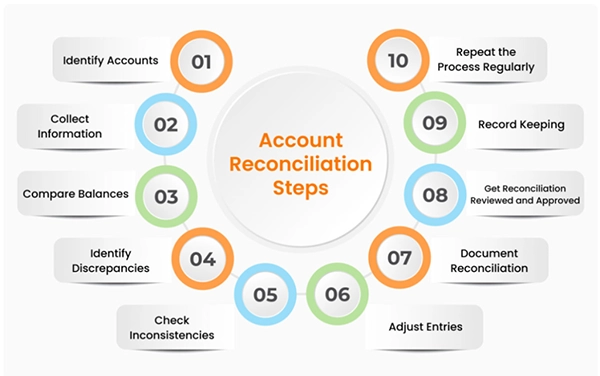
The following infographic presents standard steps for reconciling accounts:
Conclusion
Reconciling accounts is just like every other process. It has some small, repeatable tasks that need to be done within a particular duration.
Map the process, split duties, standardize templates, and build light automation around solid evidence. Keep an eye on controls and fix what breaks fast. With that rhythm, your numbers tell a clear story month after month.
Author - Dushyant K

Finance Writer
Related Posts