How Modern Firms Leverage Marketplaces for Operational Efficiency
“Efficiency is doing things right; effectiveness is doing the right things.” – Peter Drucker (Austrian- American consultant and educator)
Recent reports project that the B2B marketplace economy will hit around $4 trillion in GMV soon. That isn’t just a stat; it is a shift in the very fabric of how business is done.
Growth no longer needs massive teams or long-term leases. In today’s market, agility is the only real currency. Whether you are a solo founder or a firm leader, you can now access ‘plug-and-play’ infrastructures once reserved for the Fortune 500.
This article dives into how you can stop owning every asset and begin arranging them for maximum efficiency.
Key Takeaways
Shift from fixed costs to variable costs.
Use marketplaces to plug skill gaps instantly.
Diversify your vendor base to mitigate risk.
The Marketplace Advantage: Flexibility at Scale
By removing the heavy anchor of physical ownership, businesses gain unmatched flexibility.
Elasticity transforms fixed costs into variable ones. Instead of building a warehouse for a seasonal spike, you tap into on-demand logistics, shedding the bloat as soon as the demand cools.
Speed becomes your primary tool. Marketplaces eliminate the standard bureaucratic process that takes months for testing and contract approval by providing immediate access to global talent and infrastructure through their API systems.
The ability to move quickly enables you to leave behind all competitors who need more time to make their business transitions.
Reducing Operational Costs Through On-Demand Services
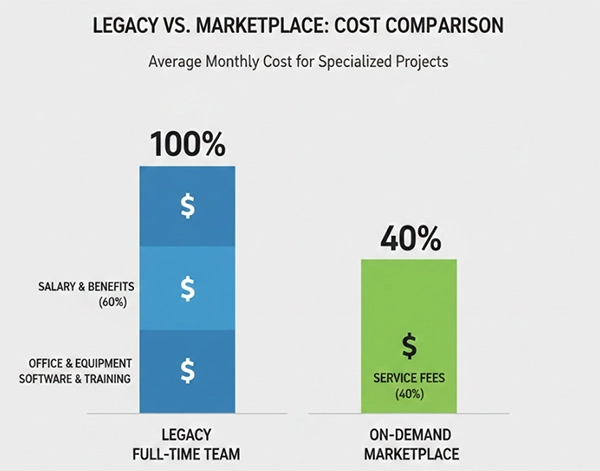
Stop paying for full-time departments to solve part-time problems. Firms slash overhead by 30% by moving non-core functions to specialized marketplaces. You save on salaries and hidden costs such as software and office space.
This lean approach trades a heavy anchor for high-performance sails, liberating capital to reinvest directly into innovation and aggressive market expansion, ensuring that your enterprise remains perpetually agile in a volatile landscape.
This graph shows the substantial savings that are achieved by shifting from heavy fixed overhead to agile, on-demand marketplace solutions.
Streamlining Procurement and Supply Chain Management
If your procurement process involves twenty emails and a fax machine, you are losing money. The modern marketplace acts as a single source of truth. They provide transparent pricing and instant comparisons, ensuring that you never overpay for logistics or raw materials again.
You can achieve complete administrative control through your ability to remove all obstacles that create errors in work performance. Your supply chain achieves maximum efficiency through transparent operations that enable it to become an active resource that delivers real-time market responses.
Accessing Specialized Talent Without Long-Term Commitments
Imagine having a world where a top cybersecurity professional and a senior CFO work together for only six hours each week. Freelancers get to choose to work in the freelance industry because it gives them the ability to create their own work schedule while choosing their tasks.
The system gives you access to the brain function of the machine without its accompanying operational responsibilities. It allows you to handle high-level assignments that exceed your current financial capabilities.
You get flexible expert support that helps your organization make strategic decisions based on the expertise of experienced professionals without paying for a full-time executive.
Do You Know? Half of the global giants now source high-skill labor through the freelance market.
Enhancing Operational Efficiency Through Shared Resources
The collaborative economy isn’t just for car-sharing; it’s for workspace and asset optimization too. If you are looking to minimize the footprint of your physical operations or find flexible housing solutions for relocating project teams, spareroom.com offers a practical solution.
It helps you manage living resources without the rigidity of long-term commercial leases. Sharing resources means sharing the risk and the cost, which directly increases your profit, turning static operational expenses into fluid strategic advantages that foster rapid organizational growth and stability.
Improving Time-to-Market With Marketplace-Enabled Agility
Today’s fast-paced environment demands that we focus on project delivery over achieving complete perfection. The marketplaces give you access to pre-existing software components, design templates, and distribution, enabling you to launch your product within weeks.
Your team can concentrate on delivering your unique business proposition because you chose to avoid the entire construction process. This business strategy allows you to acquire market share before your less agile competitors complete their market entry.
Your business concept develops into a dominant market force through this process that leads you to achieve your business goals.
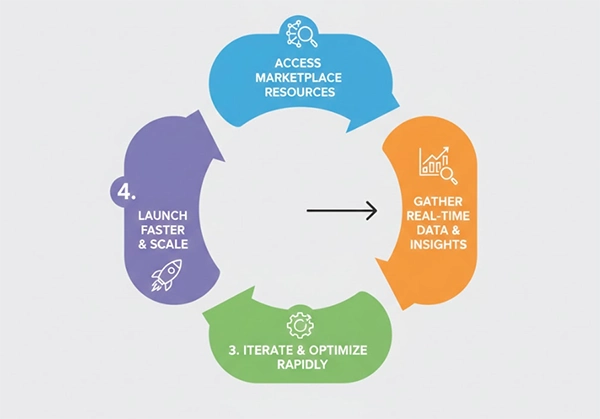
The agility loop here shows how marketplace data accelerates development through a continuous, four-stage feedback loop.
Enhancing Risk Management and Business Continuity
This redundancy isn’t just a safety net; it’s a competitive moat. When you rely on a single source, you are at the mercy of their disruptions, price hikes, or quality dips.
A marketplace environment fosters healthy competition and ensures you always have a Plan B that is already vetted and is ready for activation.
Vendor Redundancy: The marketplace environment allows you to seamlessly switch providers.
Geographic Diversity: Source from different regions to bypass localized logistics crisis or political instability.
Building Data-Driven Operations Through Marketplace Analytics
Have you wondered what the best part about digital marketplaces is? It is the data!
You get instant insights into price trends, vendor performance, and demand shifts. You can stop guessing and begin operating based on what the market is actually telling you in real-time.
Fun Fact:Marketplaces stem from the Latin word ‘Mercatus’; the first digital one made its debut in the 1980s in Boston.
This little visibility allows you to forecast with precision rather than hope. By analyzing these digital footprints, you can identify emerging inefficiencies before they impact your margin. It transforms raw marketplace data into a formidable strategic weapon for long-term growth.
Frequently Asked Questions
Ques: What is the future of marketplaces in business operations?
Ans: Success lies in navigating digital ecosystems efficiently to ensure resilience and agility in a frictionless economy.
Ques: How do I choose the right marketplace for my business?
Ans: You need to look for platforms with transparent reviews, strong dispute resolution, and industry-specific vetting.
Ques: Are marketplaces secure for sensitive business data?
Ans: Enterprise marketplaces use vetting and encryption to ensure data privacy.