Yes, installment loans like auto financing are great for a credit mix and showing a history of on-time payments.
Updated Sep 11, 2026
How to Finance a Car with Poor Credit: Banking Options and Smart Tips
“A credit score is a snapshot, not a life sentence. It reflects your past, but your current budget defines your future.”
Getting the keys to a new car should be a happy moment. However, if your credit score is low, it can feel like you are stuck behind a wall. You are not alone! Many people, about one in five, find themselves in the same situation.
Even if your score has some trouble, it does not mean that you have to stop looking. This guide is here to help you find your way. We will explain how banks check your history, where you can find the best deals, and how you can take a lovely car home without spending too much money on it. Let’s get started on your journey.
Key Takeaways
You must know your score before you go to the lot. Don’t take the first offer; check credit unions and online lenders. Cash upfront reduces lender risk and your interest. Use this loan as a tool to fix your credit for the future.
Why Car Financing Is Challenging with Poor Credit
When you visit a dealership or a bank, the lender looks at how risky it might be to lend you money. They see your credit score as a report card of your past choices. If it shows late payments or too much debt, they worry you won’t pay them back.
This is why it can be so hard to find car finance for people with poor credit without getting rejected. When the economy is struggling, banks can become more careful about who they are lending money to.
It is important to remember that lenders are not just being mean; they are trying to protect their money. They are simply weighing what you did in the past against what you might be able to do in the future.
Did You Know?
Making just one extra car payment per year can shave months off your loan and save hundreds in interest costs.
Understanding How Credit Score Impacts Auto Loans
Your credit score is the most important number whenever you buy a car. It decides if the bank says ‘yes’ and how much extra money you will pay over the next five years.
Credit Ranges and Loan Approval Criteria
Most of the banks use a score ranging from 300 to 850. Usually, anything that is under 580 is seen as something very poor, while anything ranging from 580 to 669 is just fair. If your score is low, banks will look at more than just the number.
They will check how much you earn and how long you have worked at your job to see if you can truly afford a new monthly bill.
Interest Rates and Risk Assessment
If the bank thinks lending money comes with risk, they will charge you higher interest rates. On the contrary, if someone has a good credit score, he or she will be charged a lower interest rate. However, someone with a 550 score might have to pay 15% or even 20%.
Over a five-year loan, that big difference could cost you thousands of dollars, which is almost like paying for a second small car!
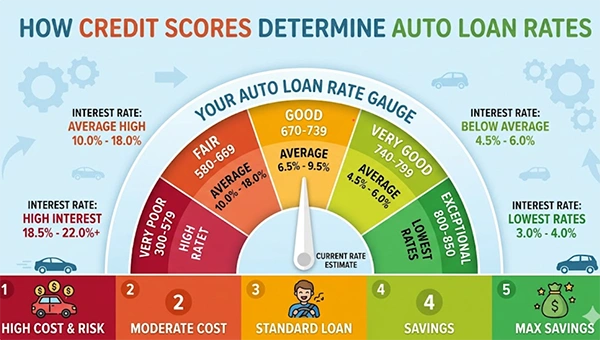
This infographic shows you how your credit score helps you get a better car loan rate and saves you money over time by lowering your costs.
Banking Options Available for Low Credit Borrowers
You might think that banks won’t help you, but you have some special programs for second-chance loans. Smaller local banks are often better than big national ones because they care more about your personal story.
It really helps if you already have an account with them. If they see your paychecks coming in every month, they are more likely to trust you. Before you apply, always request a pre-qualification. This will allow you to see what your interest rate might be without hurting your credit score. It is a safe and smart way to start your journey!
Alternative Financing Options Beyond Traditional Banks
If a big bank tells you ‘no,’ don’t worry. There are other ways to get a car that are much more flexible. Here are three main choices:
- Credit Unions
Credit unions are like small and local banks and are owned by their members. Because they are trying to make a huge profit, they can offer you lower rates and may find it easier to talk.
- NBFCs
These are special companies that only focus on lending money. They are often much more willing to help people who have lower credit scores.
- Dealer Financing
Some car lots let you pay them directly. While this is an easy way to get a car, you need to be careful. They usually charge very high interest and might ask you to pay them every single week.
Tips to Improve Approval Chances for Car Loans
Do you want to look like a hero to the bank? Well, you can make yourself look much more reliable by following these three simple steps.
- Save Up Cash: You need to pay a small part of the price at the start. If you pay 10% or 20% now, the bank will trust you more and will see that you are responsible.
- Bring a Friend: Ask someone with great credit to sign the loan with you. This will make the bank feel safe, which will help you get a better deal.
- Fix Mistakes: Sometimes, your credit score is low because of a simple error. You need to grab a free credit report and check it carefully. Fixing one small mistake can give your score a quick boost!
Fun Fact: The first-ever car loan was issued in 1919. Before that, people had to save up and pay 100% cash for their Model Ts!
How to Reduce Interest Costs on Auto Loans
Even if your credit score is low, you can still have plenty of money for a car. A great trick is to pick a shorter loan. Your monthly bill will be a bit higher, but you won’t pay interest for a long time. This makes the total price of the car much cheaper.
You should look for a simple interest loan. With this type, interest is only charged on the money you still owe. This means that if you pay even a tiny bit extra each month, you shrink your debt faster.
It also lowers the interest the bank can charge you the following month. Vyv is paying the loan off quickly, and you stay in control of your money and keep more of it in your pocket.
Common Mistakes to Avoid When Financing with Poor Credit
You need to be careful not to focus only on a low monthly payment. Dealers might offer you a small monthly bill, but they do this by making the loan last for around 6 to 7 years.
While it feels cheaper now, you will end up owing more money than the car is actually worth. This is called being underwater. Also, you need to watch out for extras like extended warranties or special coatings added at the last minute.
If you put these costs into your loan, you are not just paying for the service; you are also paying interest on them for years. It makes a small add-on much more expensive in the long run. Stick to the basics, keep your loan term short, and always look at the total price, not just the monthly cost!
Long-Term Strategies to Rebuild Credit While Repaying Loans
Getting a car loan is a great way to fix a broken credit score. Think of it as a test that you can pass every single month. When you pay your bill on time, the bank tells the credit bureaus that you are reliable and trustworthy.
If you keep this up for two or three years, those on-time marks begin to add up. Slowly but surely, your credit score will begin to climb. It shows other lenders that you have changed your financial strategies for the better.
The best part comes later. Once your score is much higher, you don’t have to keep the same expensive loan. You can go back to a bank and ask to refinance. This basically means getting a new loan with a much lower interest rate because you are no longer seen as a risky borrower.
It’s a smart cycle; you use the car to build your score, and then your score helps you save money on the car!
Conclusion
Poor credit complicates access to car finance but it does not eliminate the possibility of owning a vehicle. Specialist lenders recognise that financial setbacks often result from life circumstances rather than long term financial irresponsibility.
By presenting your current financial stability clearly, saving a reasonable deposit, choosing an affordable vehicle, and comparing specialist lenders carefully, you can secure a realistic finance agreement. With consistent repayments over time, your credit profile will improve, opening access to better financial opportunities and more competitive borrowing options in the future.
Author - Dushyant K

Finance Writer
Table of Contents
- Why Car Financing Is Challenging with Poor Credit
- Understanding How Credit Score Impacts Auto Loans
- Banking Options Available for Low Credit Borrowers
- Alternative Financing Options Beyond Traditional Banks
- Tips to Improve Approval Chances for Car Loans
- How to Reduce Interest Costs on Auto Loans
- Common Mistakes to Avoid When Financing with Poor Credit
- Long-Term Strategies to Rebuild Credit While Repaying Loans
- Conclusion
Related Posts