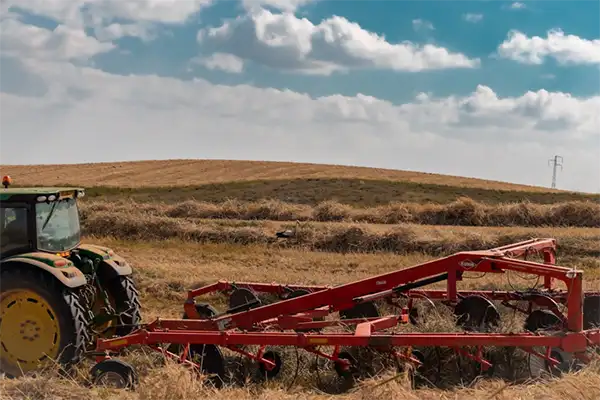
Depreciation and maintenance often outweigh the initial purchase price over time, especially for poorly matched equipment.
Updated Jul 22, 2026
Why Equipment Choice Is a Financial Decision, Not Just an Operational One
“Beware of little expenses; a small leak will sink a great ship.”
— Benjamin Franklin (USA Founding Father)
Most farmers treat tractor implements like simple tools. Pick one, get the job done, move on.
But here’s the reality: every implement is a financial decision that’s a long-term commitment. The wrong choice quietly eats into profits through fuel, repairs, and depreciation, while the right one works like a steady asset that pays back season after season.
This piece breaks down why your next equipment purchase should be treated less like a task-based decision and more as an investment strategy.
KEY TAKEAWAYS
- Equipment purchases are long-term financial commitments, not quick operational fixes.
- Oversized or mismatched implements quietly increase fuel and maintenance costs.
- Total Cost of Ownership is the most accurate way to compare equipment.
- Buying for current needs, not future hopes, keeps your farm financially agile.
The Real Cost of Tractor Implements
These tools don’t just cost what’s on the price tag.
What looks like a one-time purchase often unfolds into a chain of ongoing expenses. In recent reports, the average 200-horsepower tractor cost has increased by 287% since 1990 — more than twice the rate of inflation.
Farm implements have not been exempt. Therefore, when you purchase new machinery, you are:
- Depreciation losses over the equipment’s lifetime
- Repair and maintenance costs that grow each year
- Fuel and operating expenses based on the equipment’s efficiency
- Interest costs if you’re financing the purchase
Numbers add up quickly. And if you’ve chosen the wrong implement, those numbers hurt worse.
That’s why choosing the right Kubota compact tractors for small-scale farms and matched tractor implements is so crucial. The appropriate base machine and matched implements complement each other to keep costs low and productivity high.
Why Operational Thinking Hurts Your Bottom Line
Most farmers ask one question: “Will this get the job done?”
That’s a narrow lens.
The issue? It completely overlooks the economic aspect. You could purchase an implement that will do the job exactly as you want… but ends up costing an exorbitant amount over its lifetime.
Here’s a real-world example:
Two farmers need to plow their fields. Farmer A purchases an oversized implement that can get the job done in half the time. Farmer B purchases a correctly sized implement that takes slightly longer.
Farmer A likes to think they made a clever decision. Farmer A is also using more fuel and paying higher repair costs.
The data speaks for itself: machinery costs across Midwest agriculture climbed from $136 per acre in 2021 to around $171 per acre by 2024. Oversized businesses bear the brunt of that hike.
Operational thinking gets the job done. Financial thinking gets it done profitably.
Matching Tractor Implements To Farm Size
This is where costly mistakes often happen.
Buying too big or too small creates inefficiencies that compound over time.
Smaller farms have a much harder time. They can’t spread out their costs over thousands of acres. New research has found that small farms were spending $96/acre on machinery, compared to just $63/acre on big farms.
That’s a $33 per acre difference — almost entirely down to equipment choice.
Matching tractor implements to your farm size: some quick tips:
- Small farms (under 500 acres): Compact tractors with appropriately sized implements
- Medium farms (500-2,000 acres): Mid-range equipment with versatile implements
- Large farms (over 2,000 acres): Higher horsepower units with specialized implements
Match the tool to the real task — not the task you want.
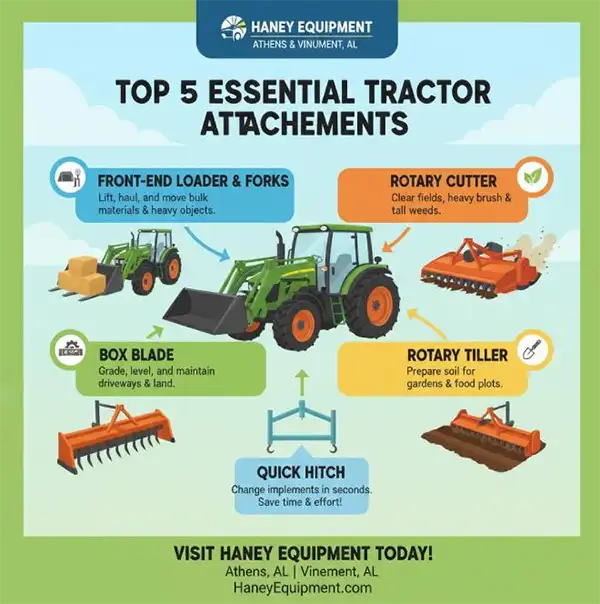
The following infographic lists all the important tractor accessories, and you have to match them to the farm size:
Don’t Buy For The Future You Hope For
A lot of farmers purchase implements with at least 10 years of use in mind.
Big mistake.
You pay for capacity you don’t need today. That capacity costs you every season — in fuel, depreciation, repairs, and storage. Buy what you need now. Upgrade later as your operation grows.
Total Cost of Ownership Explained
Total Cost of Ownership (TCO) is the number that actually matters.
It combines purchase price, financing, fuel, maintenance, and resale value into one clear picture.
This is important because… Farm machinery repair costs have risen by 41% since 2020 alone. Repair costs are cutting into farm profits.
The bottom line is that an inexpensive device that malfunctions all the time will end up costing you far more than a slightly more expensive one that just works. This is the TCO (Total Cost of Ownership) truth.
How To Calculate TCO
Working out TCO doesn’t have to be complicated. Just follow these steps:
- Get the purchase price (or financing total if borrowing)
- Estimate fuel costs over the expected lifetime
- Add expected maintenance and repair costs
- Subtract the projected resale value
- Divide the total by the expected hours of use
This gives you a cost-per-hour figure for real comparison.
Smart Buying Tips That Save Money
Now you know why buying tractor implements is an investment. These smart buying tips will help you save money.
Consider Used Equipment
The used equipment market has changed. Used implements can have tremendous value over new alternatives. You avoid the sharpest part of the depreciation curve and have someone else take that hit.
Closely inspect everything before you purchase it. A poorly used implement can end up costing more than a new one.
Match Horsepower Properly
Your tractor and implements need to be matched up. An undersized tractor will bog down with oversized implements — killing fuel efficiency and wearing parts faster.
Pulling pint-sized implements with a behemoth tractor is just as inefficient. You’re using more fuel than you need to, and paying for capacity you don’t need.
Plan Your Implement Lineup
Think in systems, not single purchases. A coordinated setup avoids redundancy and ensures compatibility.
Buy Quality Brands
Quality is important when it comes to farm attachments. Low-cost implements can fail repeatedly. Quality-built implements will run for many decades. Stick with well-known brands that are proven and have good resale value.
Bringing It All Together
Buying tractor implements isn’t just about getting work done. It’s about protecting your margins.
Start thinking about what they cost over their lifetime.
To recap:
- Look beyond the purchase price
- Match equipment to your actual farm size
- Calculate the total cost of ownership
- Compare options based on cost per hour
- Buy quality brands with strong resale value
Farmers who approach equipment like a business decision are the ones who come out ahead when times are lean.
Author - Shourya Kumar

Finance Writer
Related Posts