Work atmosphere directly affects employee engagement, motivation, and productivity, which impact the overall business performance.
Updated Jul 21, 2026
How Health-Driven Work Cultures Are Outperforming Traditional Management Models

“To win in the marketplace, you must first win in the workplace.”
— Doug Conant (Business Executive)
That means in order to win over customers, you have to win over your employees first. If they are happy, they will work so enthusiastically that your business will inevitably benefit from the boosted productivity and innovation.
Businesses are slowly realizing that their benefit also lies in the well-being of their workers. So, they are investing in it just like they do in any business growth aspect. Buying out gym memberships for employees, sponsoring vacations, regular medical checkups, and recreational breaks.
Some have even implemented a proper health supplement distribution program for employees. But it is a matter that begs extreme care, as medications can have side effects. Here is where a brand named Fenix Health Science shines. Their supplements support your mental and emotional health so you can function efficiently in your life and work. Just check out fenixhealthscience.com for more.
In this article, I’ll detail how firms are adopting a health-focused work culture as the traditional models are failing. The following sections list the benefits of the people-first culture for businesses, where diversity fits in all this, and why actual humanity will be more relevant in the future as opposed to the popular belief.
KEY TAKEAWAYS
- The traditional output-focused organizational culture is going obsolete.
- New work culture based on employee well-being is being readily adopted by businesses.
- This is enabling sustainable employee performance and improved innovation.
- Human values like empathy and collaboration are going to be even more relevant in an automation-heavy future.
From Command-and-Control to Care-and-Collaborate
The traditional “command-and-control”-based approach towards work atmosphere is slowly phasing out.
Today, the “care-and-collaborate” model is getting popular. This approach prioritizes employee well-being on all three parameters: physical, mental, and social. And firms are no fools to be adopting the model. It results in better engagement, productivity, and innovation.
Businesses are moving to supportive and trusting work environments from rigid, top-down management. And this, in turn, is leading to increased employee satisfaction and reduced turnover, overall a better-performing business.
Wellness as a Strategy, Not a Perk
Employee well-being is no longer a “nice-to-have” perk; it’s more of a business strategy.
The old, perk-based model used to offer free snacks, medication app subscriptions, or gym memberships. These were good, but not enough. They targeted the symptoms, not the underlying causes of chronic stress and burnout, like high workload or poor management.
The new model is strategy-based, which embeds employee well-being into the organizational fabric. This focuses more on flexible policies, psychological safety, and healthy leadership.
The five pillars of employee well-being that firms are targeting are listed in the following infographic:
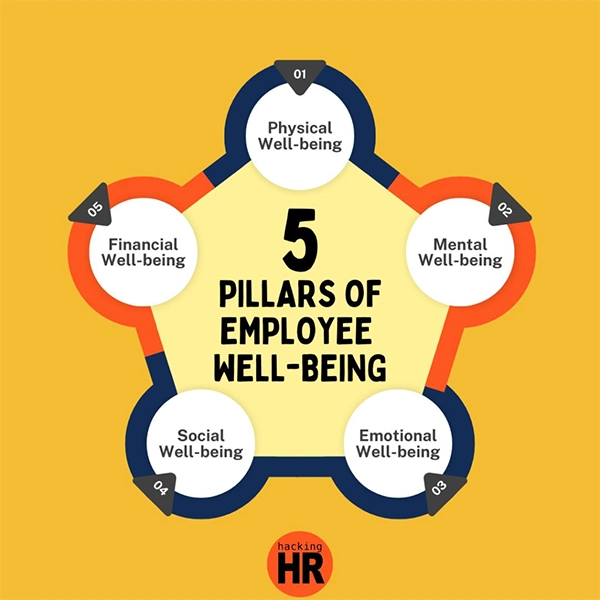
Firms are infusing this thought process into day-to-day office operations. And the benefits are also immense:
- 20% increase in employee productivity
- Fewer sick days
- Lower insurance costs
- Reduced turnover
The ROI of Putting People First
Health-driven, people-first work cultures outperform traditional models as they report:
- Reduced Absenteeism: Positive work environments decrease absenteeism by 81%.
- Increased Productivity: When employees feel supported, they function 18% more productively.
- Better Financial Performance: Companies with a strong culture exhibit a 4x increase in revenue growth and 23% greater profitability.
Some small upgrades to the office can also improve workforce focus and efficiency. Also, some simple office tweaks can help employees work effortlessly.
Case in Point: Health-First Leadership
Traditional military-style, top-down management focuses on immediate, short-term results. It used to eulogize “hustle culture,” which weighs only employee output, ignoring their well-being altogether.
But this new, health-first leadership views employee physical, mental, and social health as strategic assets. This mindset strongly believes that only overall employee well-being can result in sustainable, long-term performance. Embedding this in daily operations keeps employee burnout in check, hence reducing absenteeism.
A culture where employees feel safe to speak up, make mistakes, and be themselves fosters innovation, engagement, and results in better business financial outcomes.
Inclusivity and Equity in Health Culture
The modern employee-wellbeing-based work culture also integrates diversity, equity, and inclusion (DEI). This creates supportive environments and begets high-performing teams.
More diverse teams make better decisions, and are more engaged and creative. McKinsey reported that racially diverse and gender diverse teams resulted 36% and 2% better financial outcomes, respectively, compared to their less-diverse counterparts.
The Future of Work Is Human
Fostering empathy, flexibility, and a “culture of care, ” organizations are reducing burnout, which is resulting in the creation of a more resilient and sustainable workforce.
The earlier model was high-pressure, fear-based, and overly hierarchical structurally. This usually resulted in burnout and poor health. The newer, health-focused, constructive culture allows for open communication, strengthening trust and psychological safety among employees. And this is resulting in a better-performing workforce.
Modern managers emphasize empathy, compassion, and support rather than just delegation and surveillance. This change is achieved by a mindset shift that sees employees as holistic, living individuals with finite physical and mental capacities rather than just a resource to be exploited for company growth.
As automation is taking over most work, the human element will become the differentiating competitive factor for firms in the future. Machines cannot exhibit empathy, creativity, or collaboration.
Companies like Google and Salesforce are prime examples of this. They fostered a well-being-focused organizational culture and achieved great success in the business market.
Conclusion
Now you know why businesses are adopting a health-focused work culture and dropping the old output-based one.
This is clearly a better strategy and also the need of the hour. Your business becomes resistant to things like attrition and low growth, while the productivity and innovation metrics spike. It also encourages your employees to curate their humane virtues, which will be valuable in the AI future.
Good Health. Good Business!
Author - Dushyant K

Finance Writer
Related Posts