Yes, every business should know where its money is going and how it is being spent—for a better plan.
Updated Jul 21, 2026
Accounting Dashboard Display Guide: How to Calculate Financial Efficiency and Grow Business Sales
Have you ever wondered why many businesses struggle to grow—even after putting in serious effort? It’s because they don’t know how to analyze the numbers and act on them faster.
In fact, a recent study has shared that 82% of businesses make decisions based on poor-quality data, resulting in inefficient decisions and lost revenue for 85% of them. (Source: BetaNews)
That’s exactly where the modern accounting dashboards matter. They convert complex numbers into simple visuals, quick insights, and clear actions.
In this guide, you will take tips to better utilize the accounting displays, improve decisions and boost sales.
Key takeaways
- Business growth relies on how well and how fast you understand your numbers.
- Accounting dashboards convert complex data into something easy to understand and truly actionable.
- Adding displays for dashboards can align the team with the decisions and performance.
Why Accounting Dashboards Are Essential for Business Growth
Traditional accounting reports are no longer a standard choice in the market. Because they are very slow, boring and unworthy to read fully.
And this is exactly where accounting dashboards come across as an essential for modern business analysis and growth. They provide real-time insights into the business performance.
As a result, all decisions are up to date – resolving the real-time problems.
- Old way -> Excel sheet + confusion
- New way -> Visual dashboard + clarity
At its core, they help to spot cash flow issues early, identify profitable deals, and make on-time decisions without waiting for confusing reports.
Businesses turn from reactive to proactive decision-making, which provides them with a huge competitive advantage in the market.
What Is an Accounting Display Dashboard
An accounting display dashboard is actually a ‘visual control panel for your finances’.
Instead of getting confused with long, boring reports, one gets information with charts, graphs and key financial numbers.
Displays mean – all required information in a single place.
Modern offices use large screen displays (like LED screens) to share things in teams. This ensures you stay informed, performance is visible to everyone, and decisions happen in a rhythm.
Simple Tip: For physical dashboards, compare the price of a led screen panel with the value of improved decision-making – it often pays off surprisingly.
Market Insights
According to Global Market Insights, the display panel market is expected to hit USD 211.1 billion by 2025, with a 3.0% CAGR during the forecast period.
Key Financial Efficiency Metrics Every Business Should Track
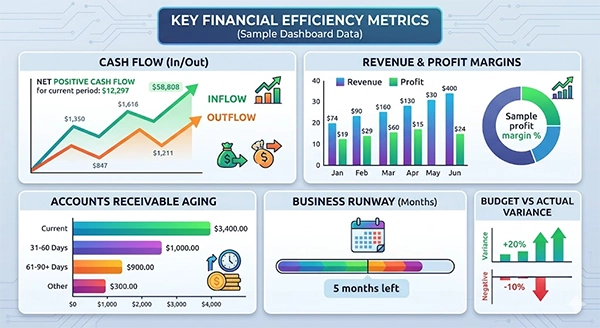
Not all numbers hold the same importance. An experienced one always focuses on the numbers that truly matter and drive the growth of the business.
Below are some of the most essential key financial efficiency metrics that every business should track:
- Cash flow: Cash in and cash out are essential to predict future estimations.
- Revenue and profit margins: This shares whether the growth is real or it’s just a crowd.
- Accounts receivable: When customers don’t pay on time, cash flow reflects it.
- Runway: The period for which the business can be operated without current cash.
- Budget vs Actual: Indicates whether the money plan is on track or off track.
These factors allow a business to connect the dots, reduce extra expenditure and improve decisions. To save more, also learn how access control systems help prevent financial losses.
How to Use Dashboard Data to Improve Business Sales
This is the point where many businesses make mistakes – they track data but fail to effectively use it for better growth.
A good dashboard should answer one straightforward question: What to do next?
When answered clearly, it helps to identify high-performing products, improve pricing strategy, optimize sales channels and have an estimation of future sales.
Knowing what to consider from the dashboard is essential to take full advantage of it. Otherwise, the change in growth might not be clearly visible.
Many businesses often prefer to outsource professionals for better use of dashboards. But is it even a sustainable choice? Yes, learn how outsourcing cuts costs without cutting corners.
Benefits of Data-Driven Financial Monitoring for Businesses
When dashboards are used effectively for a considerable period, the benefits compound over time. Below are some of the most visible impacts:
- Faster Decision-Making: No more waiting for reports to take action; everything will be shared in real-time.
- Increased Accuracy: Automation reduces manual errors and puts focus on reliability.
- More Efficiency: The wasted time on understanding data gets utilized in taking action.
- Clear Goals: Everyone, from the basic employee to the CEO, gets clear about the future goals and things to do for them.
- Better Growth Strategy: With real-time data, businesses can make fast decisions in a smart way.
The benefits of using modern dashboards are not limited to these and evolve with the business type, requirement and future plan.
These must have provided you with a glance at how decisions can be made better with modern technology. And one of the other features is open banking. Explore how accounting platforms integrate open banking.
Conclusion
In the end, accounting dashboards are no longer optional to have but have become a necessary growth tool. They help to convert the complex, confusing and boring financial data into the kind that helps to make better decisions and improve efficiency.
As a result, smooth operations are achieved where every team member understands their role. And when this is combined with modern displays, they become more powerful.
As a result, the operations are not just seen and understood with reports—they are improved daily.
Author - Veeramanchineni Lalitha

Masters of Business Administration from St Joseph's Institute of Management (Banglore)
Related Posts